Six things worth knowing before you book anything
- There is one food walk, and it is the one to book. Three and a half hours, thirteen tastings (eleven food, two drink) across five cafés and restaurants, ending at Fløirestauranten with the city underneath you, return Fløibanen tickets included, maximum eight people. It is also the only food-first listing in the city, rather than a sightseeing day with something to eat attached. A closer look at it.
- The longest listing is a bus day. Six hours to the Hardangerfjord and back, in English and German, and the food in it is one freshly made waffle and a small tasting of a local drink. Everything else you eat, you buy. Book it because you want Steinsdalsfossen and the fjord, not because you want lunch. What the day actually contains.
- Read the dietary line before you read anything else. The food walk is not suitable for vegans or vegetarians, though options are available on 24 hours’ notice with an adjusted offering. The aperitivo tour is not suitable for vegans or vegetarians at all, and it is 20 and over because alcohol is served. This is the most common way somebody wastes a booking here. Every listing’s wording.
- The smallest walk is a private one. The culinary heritage walk — two hours, up to three people, the Fish Market for about an hour and Bryggen for about an hour — is the only one you do not share with strangers, and its listing warns the programme may vary with the date and how busy the city is. A closer look at it.
- Ninety minutes, step-free, and genuinely local. The cider tasting meets at Bergen’s first dedicated cider bar and pours craft ciders from Hardanger — a protected geographical indication, apples grown in the seven Hardanger municipalities, concentrate banned, pressing and fermentation in the region. It is a tasting, not a meal. Why Hardanger cider tastes the way it does.
- Nearly every famous Norwegian dish belongs somewhere else. Brown cheese was made in Gudbrandsdalen in 1863, roughly 400 km away over the mountains, and it is not technically cheese. The matpakke descends from a 1932 Oslo school scheme. Fårikål is the national dish, voted so on the radio. Bergen’s own dishes are quieter and better. What Bergen is actually known for.
What the tastings include, and what Bergen simply does not sell
Taken from what the six listings say about themselves. Most of the disappointment on a food tour here sits in the second column, and almost none of it is about the food.
Stated as included
- Thirteen tastings on the food walk, eleven food and two drink: fresh seasonal seafood, three cider tastings, traditional sardines, award-winning local chocolate, a brown-cheese cheesecake, a local meat and cheese platter, local apple cider, and seasonal meat and fish at Fløirestauranten. Whether you pay again on the day
- Return Fløibanen tickets, bundled into that same walk. The funicular opened in January 1918, climbs 302 m over 848 m of track in about six minutes, and carries roughly 2.4 million passengers a year in two cars called Rødhette and Blåmann. The funicular on its own
- Every drink on the aperitivo tour — seafood, local cider, wines, champagne and Norwegian specialities across several stops, finishing at a rooftop bar in the city centre. Individual stops are not named on the listing. Ages 20 and over, maximum six, and it needs two people before it runs at all. The aperitivo tour, close up
- A car each way on the home-hosted lunch, from the Hurtigruten Terminal, Loddefjord Terminal or Deli de Luca Jernbanestasjon — roughly ten minutes out, about 105 minutes at the table, ten minutes back. There is a small dog in the house, and the listing says participants must not be allergic to dogs. What two and a half hours at a stranger’s table is like
Not included, and not on offer anywhere
- A cooking class. There is not one in Bergen on the platform, in any kitchen, at any length. If making the food yourself is what you wanted, this city cannot sell it to you. Everything that does exist
- A brewery or beer tour, and a tasting at the fish market. Both absent, the second one remarkable: the market is the most photographed thing in Bergen and nobody sells a tasting inside it. The indoor hall next to it
- Gratuities, on the food walk. That is the listing’s wording, and it is worth knowing that Norway has no customary percentage and no established norm for tour guides at all. Nobody at the end of your walk is waiting for a figure. Tipping, without an invented number
- Step-free access on everything. The food walk and the cider tasting are wheelchair accessible. The bus day does not allow non-folding wheelchairs or non-folding strollers. The aperitivo tour runs over cobbles into small venues and tells you to ask in advance. The home lunch says nothing, which is not the same as yes. What each listing states
Bergen’s food, in the order you walk into it
Eight places inside a twenty-minute radius of the harbour, and what each one is for.
None of the six listings publishes a stop-by-stop route, and two of them say the programme can change with the date. So this is the city rather than any one itinerary: the counters, halls and buildings a food tour in Bergen is drawn from, laid out the way you would meet them walking in from the harbour. Learn these eight and you can do most of it yourself.
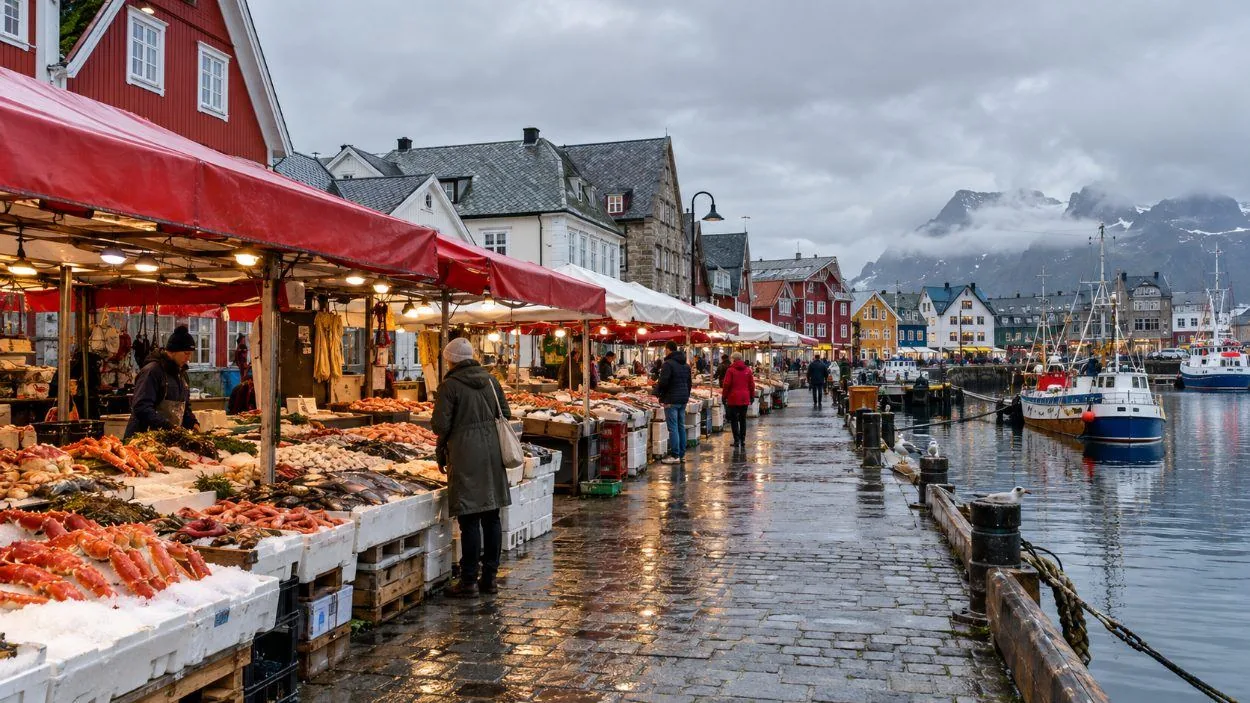
- Fisketorget, the Fish Market — A market on this harbour is mentioned as far back as 1278, moved to its present site by Christoffer Valkendorf in 1558, reorganised after the city fire of 1702, and cut back by 350 m² in 1972. The stallholders are named individuals, not anonymous vendors, and there are Greek and Thai stands among the seafood. The market, and the argument about it.
- Mathallen, indoors and open all year — Mathallen på Fisketorget opened in 2012 with permanent shops, restaurants and the tourist information office under one roof. The outdoor market is seasonal and opens on 1 May. Hours move around, so check before you go rather than trusting a printed time. Five years of my life were behind a counter in here.
- Bryggen, and the kitchens behind it — German merchants traded on this quay from the 1230s; the Hanseatic Kontor was founded around 1360, outlasted the League’s other three, and ended in 1754. Stockfish and fish oil went out, grain, flour, malt and beer came in, and in the 1300s dried fish was over 80% of Norway’s exports. Open fire was banned in the wooden tenements, which is why all the cooking happened in the Schøtstuene, the merchants’ communal assembly halls. Inscribed by UNESCO in 1979. Stockfish, skrei and the trade.
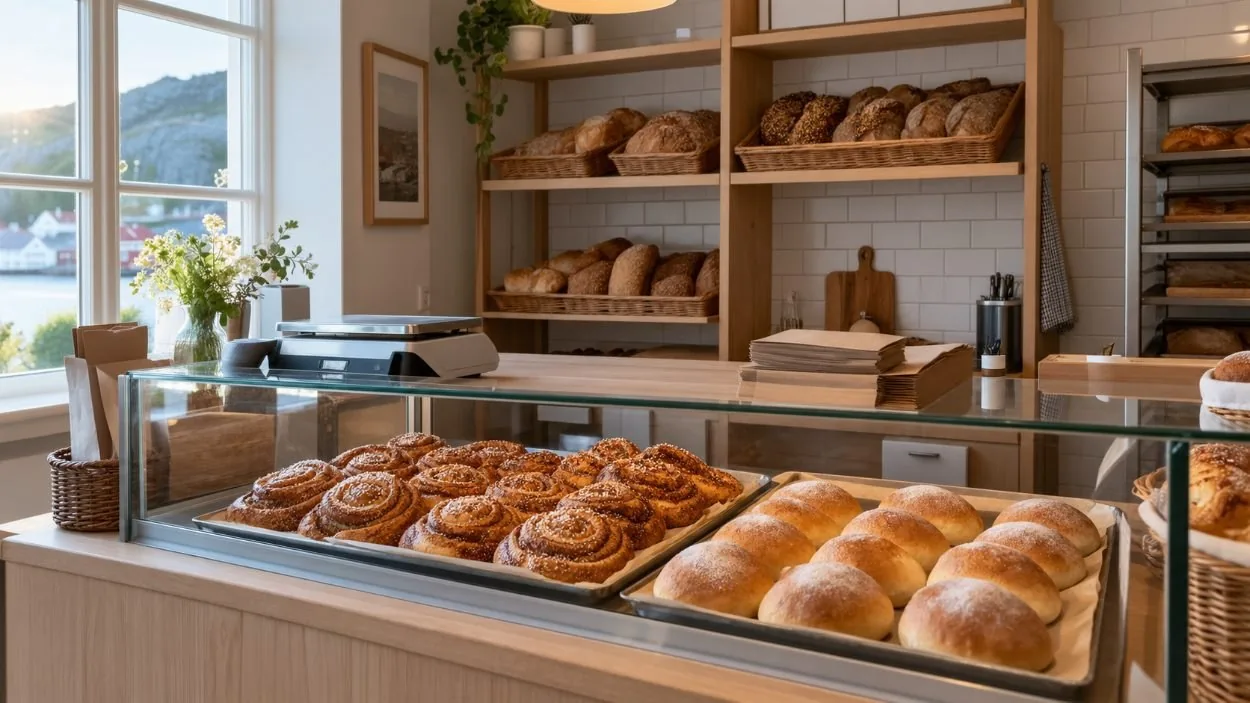
- A bakery counter, first thing in the morning — The skillingsbolle is the bake this city is known for, and the Hanseatic merchants brought it from Germany in the 1500s — five hundred years is long enough for an import to become a local. The name means “shilling bun”, after what one of them once cost. It used to have raisins in it; they vanished in the shortages of the Second World War and never came back. The bun, in full.
- Søstrene Hagelin, for fishcakes — A fishcake and fish-pudding counter and a genuine Bergen institution, of the kind that no tour will take you to because it takes four minutes and involves no guide. This is what a weekday lunch in this city actually looks like. Where people who live here eat.
- Vinmonopolet, if you want a bottle — Anything above 4.7% ABV is sold only by the state monopoly, which closes on Sundays and public holidays. Shops may sell beer up to that strength, but national law caps sales at 20:00 on weekdays and 18:00 the day before a Sunday or public holiday, forbids them on Sundays, public holidays and on 1 and 17 May — and a municipality may set tighter hours than that, never looser. Buying a drink to take away.
- Bergen’s first dedicated cider bar — Where the ninety-minute tasting meets, in the city centre; the street address is not published on the listing. What gets poured is “Sider frå Hardanger”, a protected geographical indication since April 2009: apples grown in the seven Hardanger municipalities, concentrate banned, pressing and fermentation in the region, cool fermentation at 6–12 °C. Tastings rather than meals.
- Fløibanen, and the restaurant at the top — Six minutes and 302 metres of climb from a station behind Bryggen to Fløyen, on a line that opened in January 1918. The food walk ends up here at Fløirestauranten with seasonal meat and fish and the whole city laid out below, and the return ride up and down is part of the walk rather than a ticket you buy. The funicular, and when it skips the middle stops.
That is a walkable city’s worth of food, and the honest shape of what a guided tour here adds: somebody standing beside you saying that the brown cheese is not cheese, that the fish soup is meant to taste sour, and that nobody is waiting for your tip. One day, built around eating, or whether a tour is worth it at all.
How to choose between them
Decide whether you want food or a fjord
This is the whole decision, and getting it wrong is the commonest mistake in Bergen. If you want to eat, there is one dedicated food walk: three and a half hours, thirteen tastings, capped at eight. If you want the Hardangerfjord, Steinsdalsfossen and a waterfall you can walk behind, the six-hour bus day is a good one — and its food is a waffle and a small tasting. Both are worth doing. They are not alternatives to each other.
Read the restrictions before the highlights
The food walk is not suitable for vegans or vegetarians, with options on 24 hours’ notice and an adjusted offering. The aperitivo tour is not suitable for vegans or vegetarians and is 20 and over. The home lunch has a small dog in the house and asks that nobody coming is allergic. The bus day refuses non-folding wheelchairs and non-folding strollers and recommends non-skid waterproof shoes. Every one of those is in the listing; none of them is in the photographs.
Decide how big a group you want to be in
The shelf runs from a private walk for up to three people, through a table set for four in somebody’s home and an aperitivo tour capped at six, to a food walk capped at eight — and then a coach to the Hardangerfjord. The cap changes the day more than anything else on the listing: how often you can ask a question, how long each stop takes, and whether you are a guest or an audience.
Check live dates below
Live availability and instant confirmation come straight from GetYourGuide, and every listing here offers free cancellation up to 24 hours before it starts. We are an independent guide rather than the operator of any of these. Whether you need to book ahead.
Dates for the one listing that is genuinely a food tour
A Taste of Bergen runs three and a half hours from the entrance to the tourist office, at the bottom of the stairs, and works through thirteen tastings — eleven food, two drink — across five cafés and restaurants before riding the Fløibanen up to Fløirestauranten. Maximum eight people, wheelchair accessible, return funicular tickets included, gratuities not, free cancellation up to 24 hours ahead. It is not suitable for vegans or vegetarians, though vegetarian and vegan options are available on 24 hours’ notice with an adjusted offering. A closer look, including who should book something else.
Three listings that answer completely different questions
Compare the key details of each activity at a glance. All six, side by side.
| Bergen: Old Town and Waterfalls Guided Tour with Waffles | The actual food tourBergen: A Taste of Bergen Food Tour with Fløibanen Funicular | Bergen: Norwegian Cider Tasting Experience | |
|---|---|---|---|
| Rating | 4.8 from 320 reviews | 4.9 from 47 reviews | 5.0 from 11 reviews |
| How long | 6 hours | 3.5 hours | 1.5 hours |
| How much food is in it | One waffle and a small tasting of a local drink. Everything else you buy | 13 tastings, 11 food and 2 drink, across five cafés and restaurants | A guided tasting of craft ciders from Hardanger. No food stated |
| Where it goes | Fossen Bratte, Norheimsund, the Hardangerfjord, Salthammeren, and Steinsdalsfossen — the waterfall you can walk behind | Five cafés and restaurants, then up the Fløibanen to Fløirestauranten on Mount Fløyen | One room: Bergen’s first dedicated cider bar, in the city centre |
| Meets at | The Fish Market, Nøstegaten 40, and ends there | The entrance to the tourist office, at the bottom of the stairs | The cider bar; the street address is not published on the listing |
| Group size | An air-conditioned bus or van | Maximum 8 | Not published |
| Languages | English and German | English | English |
| Accessibility | No non-folding wheelchairs or non-folding strollers. Non-skid waterproof shoes recommended | Wheelchair accessible | Wheelchair accessible, and the shortest thing on the list |
| Diet | A waffle is a waffle. Nothing else is stated | Not suitable for vegans or vegetarians, though options are available on 24 hours’ notice with an adjusted offering | Alcohol is served, so Norway’s own age rules apply in practice |
| Book it if | You want the fjord, a waterfall you can stand behind, and a long day with good stories in the van | You want to eat, to be told what you are eating, and to end the afternoon looking down at the city | It is raining, you have ninety minutes, and you would like to understand one protected local product properly |
| The thing to check | That you understand this is a sightseeing day with a waffle in it, not a food tour | That everybody coming eats fish, meat and dairy — or that you have given 24 hours’ notice | That a tasting is what you want, because this is not a meal |
| Book this | Book this | Book this |
Photo Gallery
Nine corners of eating in Bergen
Counters, halls and plates from a twenty-minute walk around the harbour. Tap any of them to open it full size.
Four listings that are genuinely different from each other
The food walk, three and a half hours and the only food-first listing in the city. The home-hosted lunch, a table set for four, where the thing being sold is the conversation as much as the meal — and where there is a small dog in the house. The cider tasting, ninety minutes and step-free. And the six-hour bus day, which is a good day out and a bad food tour. The other two — an aperitivo tour for ages 20 and over, and a private heritage walk for up to three people — are on the full list. Which one is best, answered properly.
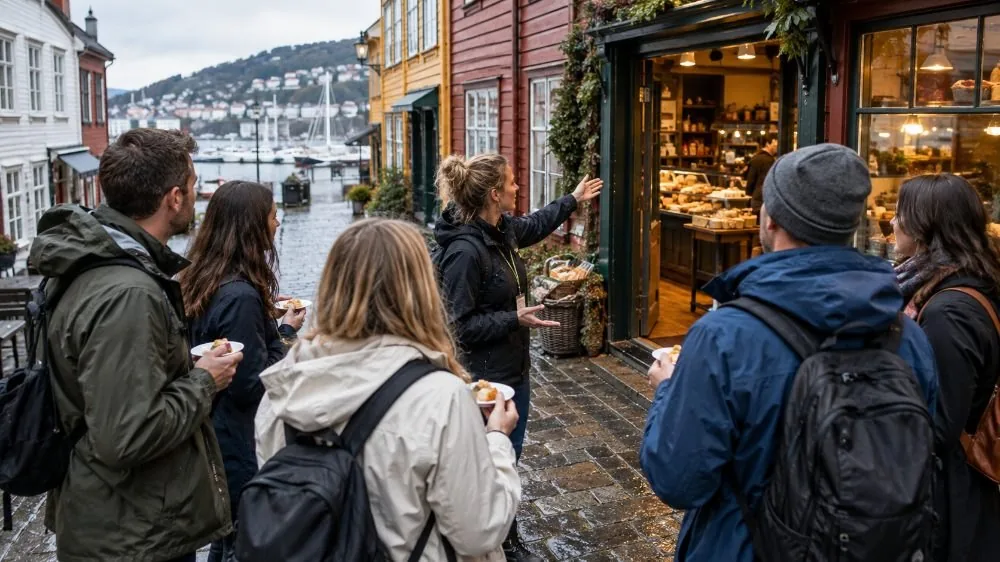 The only real food walk
Bergen: A Taste of Bergen Food Tour with Fløibanen Funicular
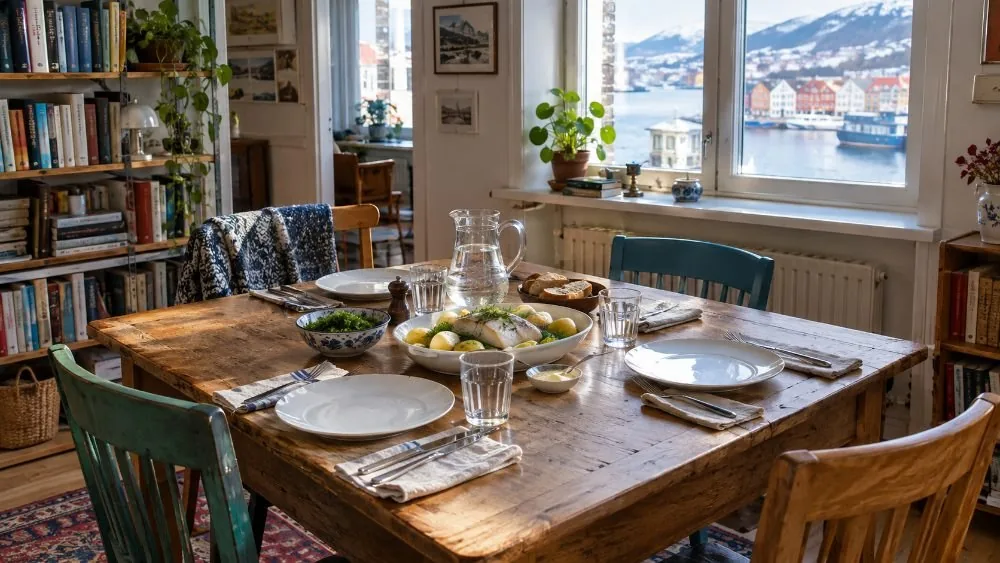 Somebody’s kitchen
Bergen: Home-Hosted Lunch with a Local
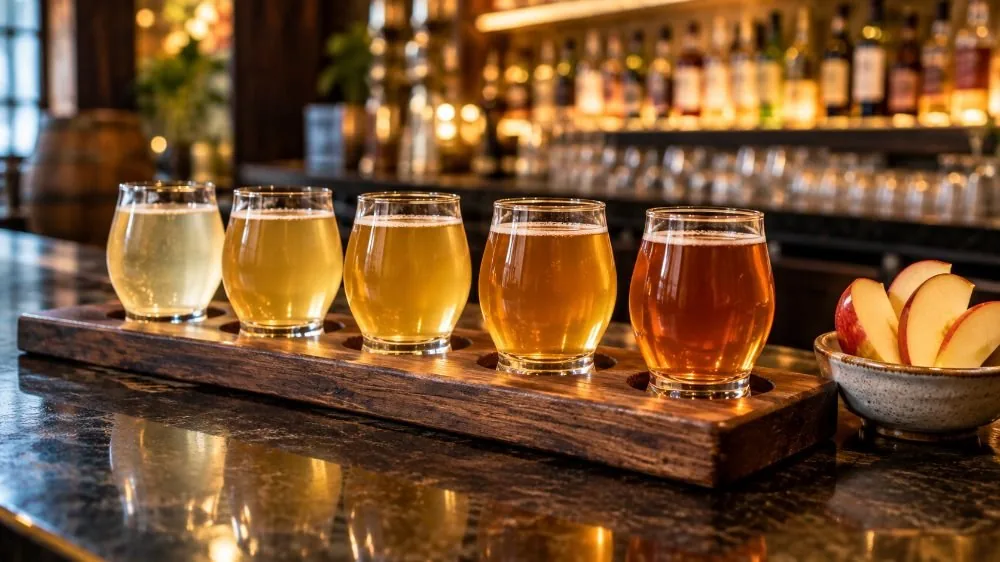 Shortest · step-free
Bergen: Norwegian Cider Tasting Experience
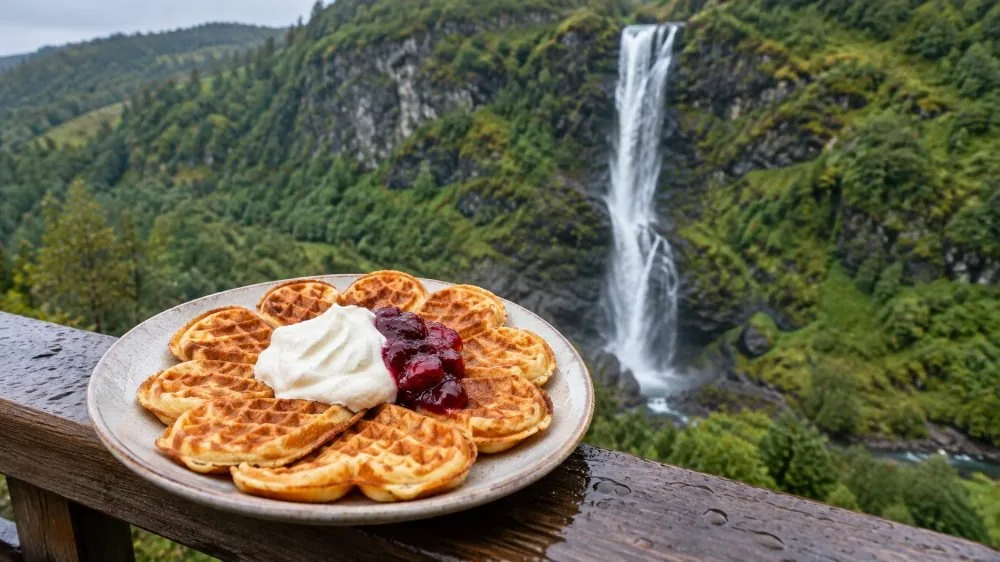 A day out, not a food tour
Bergen: Old Town and Waterfalls Guided Tour with Waffles
Four things I answered every day on the counter
Five years on a counter in Mathallen, at the fish-market end, explaining the same small handful of things to visitors between about ten and about four.
Is the brown cheese actually cheese?
No, and I must have said that four thousand times. It is made from whey, which is what is left over after cheesemaking, boiled down with cream until the milk sugars caramelise — so it is a by-product turned into something, rather than a curd cheese. A dairymaid called Anne Hov worked it out in 1863 at a mountain farm near Gålå in Gudbrandsdalen, about 400 km from here over the mountains, and she got the King’s Medal of Merit in silver for it in 1933, aged 87. Slice it thin with the slicer, not thick with a knife; thick is how visitors learn to dislike it. Brown cheese, properly explained.
Why does the fish soup taste sour?
Because it is supposed to. That is the single thing that makes bergensk fiskesuppe Bergen’s rather than anybody else’s: it is seasoned with vinegar and sugar and comes out slightly sweet-and-sour. Built traditionally on stock from young saithe bones, with finely shredded vegetables, fish balls, and both sour cream and cream in it; the old recipes keep asking for pickled purslane. People send it back sometimes, which is the saddest thing that happens in a food hall. The soup, and why the vinegar is in it.
Do I need cash, and do I tip you?
Cash is about 3% of all payments in Norway now, cards are 59% of what happens at a till and phones 37% and climbing. So practically, no. But since October 2024 a business selling to consumers on staffed premises has had to offer a cash option where other methods are available, enforceable with fines since May 2025 — so a shop cannot simply refuse your notes, although it can refuse more than 25 coins of one denomination. Vipps, which everyone will tell you to get, needs a Norwegian phone number, bank account and national ID number, so you almost certainly cannot. As for tipping: it is voluntary, no service charge is folded into the stated price, staff are on full wages, and for tour guides there is no established Norwegian norm at all. Cash, card or phone, and tipping without an invented percentage.
Which tour should I actually book?
If you want to eat, the food walk, and it is not close: thirteen tastings, eight people maximum, and it ends at Fløirestauranten looking down at the roofs. Check first that everybody coming eats fish, meat and dairy, or give 24 hours’ notice and take the adjusted offering. If it is pouring and you have an hour and a half, the cider tasting is step-free and good. If you want to sit at a Norwegian table and ask questions, the home lunch, a table for four — there is a dog. And if what you really want is the fjord, book the six-hour day for the fjord, not for the waffle. The long answer.
Can’t make these dates?
Browse more available Bergen food tours and find one that fits your schedule — all with instant confirmation and free cancellation.
Eating in Bergen, and what a food tour here is really selling
I grew up in Sandviken and spent nine years behind food counters here — four in a bakery on Nordnes where the skillingsboller came out at half past six and were gone by nine, then five in Mathallen at the fish-market end, answering the same six questions every day. No, that is not cheese. Yes, the soup is supposed to taste sour. No, you do not need to tip me. I write this because I got tired of watching people book a bus trip thinking it was a food tour.
One food walk, and a shelf of things that are not one
Bergen has been a UNESCO Creative City of Gastronomy since 2015, the only one in Norway, and it has exactly one dedicated food walk you can book: three and a half hours, thirteen tastings, eleven food and two drink, ending at Fløirestauranten on Mount Fløyen with the funicular ride included. Eight people maximum, wheelchair accessible, and the only food-first listing in the city. Check the dietary line first: it is not suitable for vegans or vegetarians, and vegan and vegetarian options come on 24 hours’ notice with an adjusted offering. Both are true.
Around it: a ninety-minute cider tasting, step-free and good in the rain; a lunch at somebody’s own table, two and a half hours, with a small dog in the house; a three-hour aperitivo tour, ages 20 and over, which needs two people to run; and a private two-hour heritage walk for up to three. No cooking class exists here, no brewery tour, and no tasting at the fish market, which I still find remarkable. And the longest of the six is a six-hour bus day to the Hardangerfjord whose food content is one waffle and a small tasting of a local drink. Go for Steinsdalsfossen, the waterfall you can walk behind. Do not go for lunch. The six, side by side, and what the fjord days actually feed you.
Almost nothing famous about Norwegian food is from here
Visitors find this part hardest. Brown cheese was made in 1863 by a dairymaid called Anne Hov, at a mountain farm in Gudbrandsdalen, roughly 400 km away over the mountains; she got the King’s Medal of Merit in silver for it in 1933, aged 87. It is also not cheese, because whey is what is left over once cheese is made. Better than the myth. Fårikål is the national dish because a radio programme voted it so, reconfirmed in 2014. An autumn dish with its own festival day. The matpakke descends from a school-breakfast scheme designed for Oslo children in 1932. Oslo, not Bergen. And skolebrød is not even called that here: in Bergen it is a skolebolle. The name changes as you cross the country.
What this city does own
Persetorsk first: cod cured a long time in salt and sugar, pressed, served with egg butter, boiled potatoes and vegetables. Christmas food. My grandmother made it every year and would never say how long she pressed it, and in 2024 the city council formally made 28 January Persetorsk Day, after the idea started as a joke online. Pressed cod, in full. Then bergensk fiskesuppe, and here is the detail almost nobody mentions: it is meant to taste faintly sweet-and-sour, because it is seasoned with vinegar and sugar. That is the whole distinguishing feature. If it tastes sour, it is right. After that: prinsefisk, cod under a cream sauce with shrimp, invented here for a royal visit in 1856; røkerumpe, the smoked tail of the cod; and puspas, our fårikål with carrots.
And the skillingsbolle, which I made by the tray. The Hanseatic merchants brought it from Germany in the 1500s, so the bake this city is proudest of is an import that stayed five hundred years. The name means “shilling bun”, after what one once cost, and it had raisins until the shortages of the Second World War took them out. They never came back. Buy one before nine.
The market everyone photographs, and argues about
A market has been recorded on this harbour since 1278 and moved to where it stands now in 1558. Norwegians argue about it in public: in 2013 a national paper ran the headline Norges største turistfelle, Norway’s biggest tourist trap, quoting a marketing professor and Bergen native who said locals bought their fish elsewhere. The city’s tourism director answered that nobody was complaining and visitor numbers were rising. It still runs. Both sides of it. Mathallen next door opened in 2012, is indoors and open all year; the outdoor market opens on 1 May. The hall, and what is in it.
Three things to settle, then go and eat
The tap water is excellent, so buying it bottled is a waste. Drink it. Cash is about 3% of payments in Norway, and yet since October 2024 shops on staffed premises have had to offer a cash option. Bring a card anyway. And nobody is waiting for your tip: no service charge is folded into a stated price, and for guides there is no Norwegian norm at all. The honest answer.
Which leaves what a guided walk here is for. You can reach all of it yourself, so what you are buying is translation: somebody beside you saying that the brown cheese is not cheese, that the soup is supposed to taste like that, and that the fish market on the postcard is the part of this city’s food scene Norwegians cannot agree about. Everything you can actually book.
Frequently asked questions
Is there a food tour in Bergen?
Yes, but only one that is really a food tour. A Taste of Bergen runs three and a half hours, works through thirteen tastings, eleven food and two drink, across five cafes and restaurants, includes return Floibanen funicular tickets and finishes at Floirestauranten on Mount Floyen. It takes a maximum of eight people and it is wheelchair accessible. Around it are a ninety-minute Hardanger cider tasting, a home-hosted lunch for up to four, an aperitivo tour for ages 20 and over, and a private culinary heritage walk for up to three. There is no cooking class in Bergen, no brewery tour and no tasting at the fish market.
Which Bergen food tour is the longest?
A six-hour bus day to the Hardangerfjord, which runs nearly twice as long as the food walk and contains far less food. Its entire food content is one freshly made waffle and a small tasting of a local drink; additional food, drinks and souvenirs are not included. The day itself is good: Bergen sightseeing, a photo stop at Fossen Bratte, Norheimsund, the Hardangerfjord, the Stone Age carvings at Salthammeren, and fifty minutes at Steinsdalsfossen, the waterfall you can walk behind. Book it because you want the fjord. If you want to eat, book the food walk instead.
Can vegans and vegetarians do a food tour in Bergen?
Only carefully. The food walk states that it is not suitable for vegans or vegetarians, and then states that vegetarian and vegan options are available on 24 hours' notice with an adjusted offering. Both halves are true and both matter: you can go, but you must tell the operator a day ahead and you will not get the same thirteen tastings as everybody else. The aperitivo tour says it is not suitable for vegans or vegetarians, with no such note. The home-hosted lunch has a small dog in the house and asks that nobody coming is allergic to dogs. A separate Voss and Flam day trip on the platform is not suitable for anyone with animal, food or nut allergies at all.
What food is Bergen actually known for?
Not the dishes people usually name. Bergen's own are persetorsk, cod cured a long time in salt and sugar then pressed, served with egg butter, boiled potatoes and vegetables, traditionally at Christmas and given its own city day on 28 January by the council in 2024; bergensk fiskesuppe, whose distinguishing feature is that it is seasoned with vinegar and sugar and tastes slightly sweet-and-sour; prinsefisk, steamed cod in a cream sauce with shrimp, said to have been invented here for a royal visit in 1856; roekerumpe, the smoked and salted tail of the cod; puspas, the Bergen version of farikal with carrots in it; and the skillingsbolle, which the Hanseatic merchants brought from Germany in the 1500s and which has been the city's favourite bake ever since.
Is brown cheese from Bergen?
No. Brown cheese was created in its modern form in 1863 by Anne Hov, a dairymaid at a mountain farm near Gala in Gudbrandsdalen, roughly 400 km from Bergen over the mountains, by adding cream to cow-milk whey and boiling it down. Adding goat's milk later produced gudbrandsdalsost. She received the King's Medal of Merit in silver in 1933, aged 87. It is also, technically, not cheese: it is made from whey, a cheesemaking by-product, rather than from curds. The same goes for most of the famous ones. Farikal is the national dish, voted so on NRK radio and reconfirmed in 2014. The matpakke descends from a 1932 Oslo school-breakfast scheme. Lutefisk has no documented region of origin at all.
Do you tip on a food tour in Bergen?
Tipping in Norway is voluntary and there is no customary percentage. No service charge is folded into a stated price, staff are on full wages, and rounding up or leaving a modest amount for good table service is common without being expected. For tour guides specifically there is no established Norwegian norm at all, which is the honest answer rather than a dodge: any percentage you find online for this comes from somewhere else. The food walk does list gratuities as not included, so it is anticipating something. Tips are taxable income here, employers have had to report them since 2019, and a 2023 Supreme Court ruling held that they remain gifts from the customer to the employee.
Which Bergen food tours are wheelchair accessible?
Two of the six say so plainly. The food walk is wheelchair accessible, and so is the ninety-minute cider tasting, which at an hour and a half is also the shortest thing on the list. The six-hour fjord day does not allow non-folding wheelchairs or non-folding strollers, and recommends non-skid waterproof shoes. The aperitivo tour runs over cobbled streets into small venues, some with limited accessibility, and its listing tells you to ask in advance. The home-hosted lunch says nothing about accessibility, which is not the same as saying yes: ask before you book.
How long is a food tour in Bergen, and when should I come?
Ninety minutes for the cider tasting, two hours for the private heritage walk, two and a half for the home-hosted lunch, three for the aperitivo tour, three and a half for the food walk and six for the fjord day. As for when: Bergen's normal annual rainfall is 2,495 mm and it rains on about 200 days a year, with December the wettest month and May the driest, so an indoor tasting is a genuinely useful thing to have booked. The outdoor part of the fish market is seasonal and opens on 1 May; Mathallen is indoors and open all year. Hours move around, so check before you walk down.
Still have questions? Email us [email protected]